I climb things, climbed things, out of warm womb, fresh from first hold into new arms already breaking, wondering about climbing back up.
I climb things, climbed things, chimneys in a child’s mind looking for traces of reindeer and reasons to still believe in faith and family and catching flight.
I climb things, climbed things, out of closets and their cluttered comforts, out of skins I’d slipped into to confuse the conscious and the curiosity of others that could be cruel. Climbing can often cut.
I climb things, climbed things, into beds that didn’t know any better, mouths that choked and fingers that felt familiar, for a time, holding me to ledges of love and lust and the lies in between.
I climb things, climbed things, over waves that didn’t drown but even the sea comes over you in cycles, some you win, under others you sink, like losses and lovers and faith and fate. Sometimes climbs are a descent.
I climb things, I climbed things without ever looking back.
Now, I move forward through backward steps, through chimneys and out into flight, into folds and then out further, drawing in trust and expelling worn waves, blind to coming corners while studying the method I used to survive the last fall.
Beginning with A Restricted View from Under the Hedge to Sticklebacks and on to The Cult of the Spiny Hog, along with a classic collection of inspirational writers, Mark Davidson and his poets are turning hoglets into must-have bookshelf desirables. Over a series of interviews I will ask the same 11 questions to a group of Hedgehog poets and Mark himself, and hopefully we’ll uncover what it takes to put pen to page, poem into print and pamphlet onto that prized position on every reader’s bookshelf.
Today we are joined by Waterford based poet Robin McNamara. We may have to come back for another interview with him to find out about his favourite film and colour but, in the meantime, we get to hear all about his debut poetry collection Under A Mind’s Staircase which will be published in February 2021 by The Hedgehog Poetry Press.
Thank you so much for taking part in this series Robin, let’s fire away…
1 Why did you write this collection, what is it about and what would you like the reader to take away after they turn the last page and find that perfectly prized place for it on their bookshelf?
Firstly before I answer that, I decided to get back into writing again in 2017 after many years in the wilderness for various reasons. It was my intention to get a collection published for the last few years and thankfully I achieved that aim in October of this year when Mark Davidson of Hedgehog Poetry Press approached me about sending a manuscript and immediately offered me a publishing deal. Because of the pandemic lockdown there was so much poetry coming out of me it was unstoppable, like there was an old soul inside of me telling me to write. I wrote the collection because I had stories to tell and things to say and I wanted to share my words with others. My collection is an eccentric mix, a kaleidoscope of words bursting with vibrancy but then you turn the page and a poem covers you in darkness. Be very careful because you don’t know what emotions you’re going to feel page by page. I don’t wish to define my collection into a particular category of emotions or topics. I let the readers determine what type of poetry creeps out from under the book. The poem that stays with you; makes you think a bit more. Poems that make you think and stop and muse about the way poetry reaches out to the subconscious thoughts that we ignore everyday in our busy lives married to technology.
2 My chillout time comes from cooking, endless hours lost in the kitchen along with a blaring radio of eclectic tunes and golden oldies, but I can only chill when the cupboards are well stocked with the basic ingredients. Firstly, what is your chillout routine, your escape from the pen and all the pondering and, secondly, what are the basic ingredients you need when it comes to settling down to write- what factors or futons make the best mix for your creations?
When I’m not writing I’m watching sports on tv or constantly on my iPhone, during lockdown when I was writing my first collection I played the Xbox into the early hours, it was a great escape from everything and a reward to myself when I had done my daily discipline of writing a poem or two everyday. I never really do escape from my writing nor do I really want to. I’m constantly writing notes or poems into my iPhone or on a writing pad. I’m constantly getting ideas at 2am so obviously my creative time is midnight onwards I’ve written some of my more unique pieces then, which have been published. Basic ingredients for writing are darkness and demons and the twilight hour while the devil surfs the channels on the sofa beside me as I write my thoughts down into poetry. Leave your daytime head on the table forget about normal life, enter the twilight of the night writer’s imagination.
“I never met a man who was content with all he did or all he achieved or rested soundly at night with his millions or with only pennies. He was always hungry for something.”
Poets are like this, we can never write enough to be completely satisfied. We constantly write more no matter how many times we get published. This is what keeps me going the constant desire to write.
3 Sticking with the cooking analogy for a moment, do you follow a specific recipe for writing or do you throw all the ingredients into the bowl and see what happens?
I throw everything into the bowl of my mind, all my rage, frustrations, thoughts, fears and see what the results are and what the pen brings. Different days being different recipes, you might be in the mood for a dark poem one day and a philosophical one the next. I don’t really understand my mind at best of times so I just accept what my creative brain throws out onto the page/iPhone etc. Sometimes the most basic ingredient can result in the most powerful poem. Sometimes a poem is best left to marinate over a week or a month with edits, rewrites and so on until it’s fully matured for publication. It can be like a fine wine too, the longer you leave it the better it tastes afterwards. Good poetry can’t be rushed.
4 In these days of social media, you’re nothing if you’re not seen and in these unsettling, uncertain days of Covid, seeing, listening and buying has moved online and readings and live launches in libraries and lounges are a rare happening or else there is a limit to the amount of people in attendance. How are you dealing with having new collections coming out right now? What is your way of being seen? How are you coping with the fact that being a writer today also requires a certain amount of spotlight, certainly more than the days of Ms. Dickinson?
I would rather stick pins in my eyes than do a poetry reading and the same goes for zoom and such things. I get it, I really do, the attraction and the necessity of all this meeting and greeting and having an online presence with zoom meetings etc. I’m quite happy with how I’m doing via Twitter on having a presence in regards to highlighting my writing and I’ll have no problem in marketing and promoting my new collection in whatever capacity, but when it comes to a generalised meeting online for poetry festivals etc count me out! I’m quite content to be left alone to do my writing but yeah, prompting my book I’ve absolutely no issues doing so. I feel like I’m contradicting myself here so I hope it makes sense. I’m a bit of a social introvert but that’s how I’ve managed to discipline myself with writing every day. I definitely will do a pre-recorded recital of my poetry for your podcast, Eat the Storms, I’m up for supporting fellow poets in all their creative endeavours. I don’t mind a bit of the spotlight on me at a low wattage, it’s great to get recognised for your achievements and I’ll be in the local papers in January with an interview so I’ll be more well known then. It all helps to showcase my collection and people know me for my poetry and will buy the forthcoming book(s).
5 Speaking of being seen and getting noticed, how important are acceptances from writing journals and how do you deal with the rejection which comes, no matter how much acclaim you have received? The reality we must learn is that not everyone is going to love our work, which can be heart breaking as we’re basically offering up our poetic babies to be loved, though no one loves a baby as much as the parent. So what keeps you going? Head up and move on or hide out and wait till the hurt passes? What encouragement do you have for others starting out?
I’ll give you my experience of acceptances and rejections from this year. I only began to get more serious with my poetry from January of this year and during the summer I submitted poems to established places like Poetry Ireland Review which was a little bit ridiculous to be honest as I’m not that good yet. I did submit to some new literary sites and I considered the poems to be quite strong but when they were rejected I was quite annoyed especially when I received three rejections in three days. I began to question myself as a poet. This only made me more determined to get my poems accepted in literary sites and I ended up having about 45 poems accepted in October and November alone. So it proved to me my work was good enough especially when Mark Davidson of Hedgehog Poetry Press offered to publish my debut collection, it was validation that I was good enough. All poets have their underlying insecurity, “Am I actually good enough do people actually like my poetry?”
Always believe in yourself and look back at the rejections and see how those particular poems can be strengthened. I actually found a home for about five poems that were previously rejected so it’s all about the personal taste of the editors, learn not to take it too personally. I think the more established you become the easier it is to be accepted but it takes hard work and sheer determination, acceptances don’t just land on your lap, you’ve got to work for it. Let rejections inspire you to become a better poet!
If you’re starting out focus of writing poems then, when you have a small selection to choose from, go and submit as long as you follow the theme or guidelines given by literary sites you have as much chance as anyone. Submit to small poetry sites they’re always looking for new poets and unpublished poetry.
6 If you had to pick one piece of your own writing that most represents you what would it be and why and would you like to share it or part of it here with us?
To reiterate the answer give to question number one I’ll let the readers who buy the collection make up their minds about this. I can’t pick out one single poem as I’m still evolving as a writer so a current fave would be out of date by the time this interview goes live. I think all the poems represent a different part of my journey as a poet, a human being with the strengths and weaknesses I have, that we all have are encompassed within this first collection. I want the reader to explore themselves and make their own minds up which poems are relevant to how they feel or the mood they sense from a poem within the collection. I’ll get up off the shrink’s chair now (laughs).
7 Writing poetry, more so than any other writing form, is often the art of peeling back, removing the unnecessary, eliminating lines to uncover the hidden truth- how bare does it get for you? How difficult is it, at times, to tell your story within the lines and framework of a poem? How comfortable is it to be naked with so few words to cover over the possible discomfort or is it just a part of the process you get used to?
I don’t give it much thought to be honest, I try not to over analyse the process and then self-doubt myself in the process. In 2018 I was barely writing anything I had other creative distractions like writing for a sports blog. In 2019 I was slowly evolving as a poet and getting more work published but didn’t really have the writing discipline nor did I really study other poets styles for guidance, I guess I was still trying to convince myself I was good enough to take it more seriously than I was at the time. 2020 changed everything, I’d decided to do a writer’s course here in Waterford which opened my eyes a bit more as I met guest writers speaking at the course who spoke about their creative techniques and I totally got it, I understood their language and it was a revelation for me that I could be original and be the maker of my own destiny in writing. The pandemic lockdown of March to May was when it all clicked and I ‘became’ a poet, this was when I discovered how or what it was like to be a poet full time and I developed that hardcore discipline that’s helped strengthen my writing technique, style and quality of my poetry. It resulted in getting 70/80 poems published towards the end of August and throughout Autumn. That’s when Hedgehog Poetry Press started to notice me and offered me the publishing deal. .
8 When it comes to titles, our pieces as I said, are like children- each needing special consideration and attention- how do you name your poems, short stories, collections or novels- is the name a starting point, a midway consideration or a summation of the theme afterwards? Sometimes I worry when I come up with a really great title it might overpower the poem itself- is there a balance between the two?
I think the title of the poem if it’s interesting will draw the reader into reading the poem. I’ve tried to be clever with titles for poems, even experimenting with Latin, French and Italian titles to be a bit more sophisticated but I’ve learned not to place too much emphasis on this. I did write out a list of titles for the collection and used various working titles and eventually settled on Under A Mind’s Staircase. It’s unusual, unique and catches (hopefully) the buyer’s attention. I consider the book title to be quite important as you only have a fraction of a second to catch their attention. Having said that, I guess the title of the poems within the book take on a more meaningful significance as you want to draw the readers into reading a poem they think they may like or even relate to. That’s my goal as a poet to bring the readers inside to see what the actual poem behind the title is all about. Sometimes I work on a poem untitled until I finish it and only afterwards do I name the poems. I don’t think a title can actually overpower a poem if it’s good enough.
9 For myself, writing started in childhood as a purely cathartic process, even if I was too young to fully understand this, it was a way of self-analysing and coming to an understanding of the world and my place within it. How did you find your way to writing and what was it about the process that kept you hooked?
Writing poetry is quite therapeutic and it’s a great feeling of release, accomplishment and a buzz when a piece is completed. At the very beginning of my writing in 1997 or thereabouts it was love poems for ex-girlfriends so you can imagine they weren’t very good! I spent my childhood drawing and reading anything I could get my hands on, I certainly didn’t appreciate nor understand poetry as a kid, I was more into playing football and athletics. But I was a ferocious reader of comics, encyclopaedias, history books, biographies and later in life biographies of poets and writers like James Joyce, Robert Frost and Dylan Thomas. All this helped me to gain knowledge of the world around me. I eventually was drawn back to poetry in late 2017, I previously did not believe I could write anything like poetry which I’d considered to be a higher form of art for those who were quite intellectually developed and had a superior knowledge of the English language. I slowly but surely began to have more faith in myself when I discovered that nobody can tell you what you can and can’t do and what your limitations are. The sports writing gave me the belief that I was a good enough writer and so I naturally veered towards taking it more seriously with the publication of my first poem, God’s Waiting Room in 2018. There’s so much scope and really no rules in style or techniques that you can or can’t use in writing a poem, you just have to make sure it’s not crap! The experimental side of poetry and the unlimited amount of things you can draw inspiration from is what keeps me hooked. I’ve finally found the medium I’ve been searching for to release my creativity and I’ve never looked back since. The writing community is quite supportive for indie writers and although we strive to be published by established literary publications it’s not really that important but it’s nice if they recognise that your work is good.
10 For the most things that fulfil me in life, the surrounding visuals are very important, and over the past few years the relationship between the photograph I take and poem I write becomes integral to the success of both- sometimes I never know which inspired the other more. What is your favourite accompaniment while creating a piece of writing?
I like to use fancy words or words I’ve learnt in a poem but not for the sake of sounding clever. If they don’t work within the context of a poem then I remove them. I’m always looking for the origin of a word and I have a list of words to use for inspiration to start a poem. That’s not really answering the question though is it? Sometimes I listen to music on my iTunes as it helps the creative flow of writing and can inspire. Very much like my poetry, I have quite an eccentric mix of music that I listen to, classical music, pop, hip hop, soul. My playlist also consists of the latest music from established artists and some more obscure and relatively unknown artists. Music, like poetry if it’s good, people will listen/read regardless of who it’s from. The connection to something creative is the most important thing and music definitely helps the creative juices flow.
11 The more I write, the more it becomes my oxygen, the more my hand shapes itself to the shape of my favourite pen or now my iPhone which has replaced the laptop as the most at-hand instrument to record my thoughts, and these days I have to catch them quick or they are lost forever. As a kid I wanted to be a famous fashion designer and lived in 4 different countries working for various fashion brands, though the writing was always there. Since then, cooking and photography have come more into the forefront. What were your childhood dreams, what were the jobs that followed to fulfil them or just fill time and what, other than writing, would you consider doing in order to express yourself?
I’ll answer them back to front. For expressing myself other than writing I’ll give you an answer from a blog interview I did with Joe Cushnan for ‘A Dozen Questions’. Prior to lockdown last March, I was writing a script for a musical based on a famous football team. I had a cast picked out, musical director, a musical score and a cast, with a well-known comedian in a lead role. Of course it didn’t leave base camp when the pandemic arrived. Doing a play or musical was never something I ever envisioned myself doing. Yes I know there’s writing involved but the whole theatre aspect of it being behind the scenes, getting a cast together creating something from nothing really appeals to me. Creating a story via music and acting for an audience would be a pretty cool thing to do. I’d love to do something with film or a tv documentary that would be really interesting, although I don’t think I’d have the patience! Childhood dreams consisted of being a professional footballer, long before money was the main motivation for a lot of young players. Then I wanted to be a soldier or was it the other way round? As I come from a fishing village I fished on my father’s boat during summertime then I worked in the local hotels during the summer holidays. I went to college to study Graphic Design then Advertising in Dublin and had a stint as a junior graphic designer in a studio in Dublin but it wasn’t really me. I ran away to Copenhagen where I worked at the Hard Rock Cafe in 1999, returned home 2004 got a job at Cartamundi (maker of Monopoly games) been there ever since. It’s my paying the bills job, my writing is my true vocation and represents who I actually am. It would be great to be involved in some kind of job that involves creativity like the theatre instead.
Thank you so much for taking the time to share your thoughts, insights and mental workings with us. It’s been a pleasure to dive inside your head from the comfort of our own armchairs. Before we depart, if you were to leave us with one line, one phrase, one lyric, a one-liner or a once-in-a-life-time admission, either yours or someone else’s, what would it be?
Damien why were the questions so hard??! Could you not have asked me what my favourite colour or film was??! I’m kidding. When I was in the depths of writing during the dark and quite months of lockdown when the world was still, I felt that there was a presence with an old soul within me helping me to write my collection. I’m pretty sure it was my ancestor, an Irish speaking poet, Donnchadh Rua Mac Con Mara. An Irish priest who was a bit of a scoundrel getting thrown out of the priesthood for womanizing and drinking. He lived from 1715-1810. His name in English was Red Donough McNamara. Now I bet you weren’t expecting that answer. My collection was ghost-written!!
Robin McNamara is on Twitter as @thewindingroad1https://twitter.com/thewindingroad1 and his collection Under A Mind’s Staircase will be published by The Hedgehog poetry Press in February 2021.
Beginning with A Restricted View from Under the Hedge to Sticklebacks and on to The Cult of the Spiny Hog, along with a classic collection of inspirational writers, Mark Davidson and his poets are turning hoglets into must-have bookshelf desirables. Over a series of interviews I will ask the same 11 questions to a group of Hedgehog poets and Mark himself, and hopefully we’ll uncover what it takes to put pen to page, poem into print and pamphlet onto that prized position on every reader’s bookshelf.
Today we are joined by Vic Pickup who one day might have a poetry cafe that shuts when ideas rush in. So pull up a chair in the kitchen, grab a scone and let’s get started.
Thanks for taking the time to chat to me Vic, here we go…
1 Why did you write this collection, what is it about and what would you like the reader to take away after they turn the last page and find that perfectly prized place for it on their bookshelf?
This sequence was a happy accident, really. It was only after seeing the competition, ‘A time to think’, advertised by Hedgehog Press that I assembled the poems I’d written during lockdown and realised there was a theme emerging on its own. The sequence describes a kind of journey – although covering seemingly disparate subjects, I think the poems hold hands nicely and are sympathetic to each other’s feelings! I hope Lost & Found is accessible enough for readers to relate to personally, and feel ultimately strengthened and uplifted as the pamphlet concludes.
2 My chillout time comes from cooking, endless hours lost in the kitchen along with a blaring radio of eclectic tunes and golden oldies, but I can only chill when the cupboards are well stocked with the basic ingredients. Firstly, what is your chillout routine, your escape from the pen and all the pondering and, secondly, what are the basic ingredients you need when it comes to settling down to write- what factors or futons make the best mix for your creations?
I have three children so a bit of quiet to contemplate life is always welcome! I love walking, I am also an avid baker. I have a terrible sweet tooth so those two combined aren’t ideal! Sitting with a good book or film and my cat Freddie (after the great Mr Mercury) is a lovely thing indeed. When I do get the chance to write, I don’t need much – a window of time, a nice big tankard of coffee, and a laptop – I find I can type quicker than I can write and often it’s a challenge to keep up with my head!
3 Sticking with the cooking analogy for a moment, do you follow a specific recipe for writing or do you throw all the ingredients into the bowl and see what happens?
I find the more I think about a poem, the more I ‘lose’ it. Come to think of it, overthinking has always been my downfall in life! If I have an idea, I have about thirty seconds to splurge the bulk of it on a receipt or back of my hand with a biro or it’s gone. The ones which come into being this way are usually stronger than the ones I write to order. My favourite new trick is to write down an impromptu poem on a text message and then accidentally send it to the plumber or dentist.
4 In these days of social media, you’re nothing if you’re not seen and in these unsettling, uncertain days of Covid, seeing, listening and buying has moved online and readings and live launches in libraries and lounges are a rare happening or else there is a limit to the amount of people in attendance. How are you dealing with having new collections coming out right now? What is your way of being seen? How are you coping with the fact that being a writer today also requires a certain amount of spotlight, certainly more than the days of Ms. Dickinson?
I’m mostly communicating with others in the poetic world via social media at the moment. In large, I find the poetry community on Twitter so supportive. I think I am a bit addicted for that reason. I’m also on Facebook and Instagram, though not quite ‘down with the kids’ enough to be on TikTok like you, Damien! At first, I loved being able to access so many events online but I do find the concentration levels required for Zoom quite tiring and it can be really hard to wind down after an event. I miss seeing people. REAL performances and connections. I am so grateful for the technology that has kept us all going but I hate relying upon it and the stress it can bring about when it doesn’t cooperate. I would have loved a proper launch for Lost & Found, to do library and bookshop visits to make this all seem real and, of course, help with sales, but hey ho – I’m just glad it IS real and with a bit of creativity it’s still possible to get books out there. As for spotlight, I don’t feel particularly visible – I’m just really enjoying connecting with other poets so anything which raises my profile a bit in order to open up new opportunities and meet others who love what I love is just wonderful!
5 Speaking of being seen and getting noticed, how important are acceptances from writing journals and how do you deal with the rejection which comes, no matter how much acclaim you have received? The reality we must learn is that not everyone is going to love our work, which can be heart breaking as we’re basically offering up our poetic babies to be loved, though no one loves a baby as much as the parent. So what keeps you going? Head up and move on or hide out and wait till the hurt passes? What encouragement do you have for others starting out?
That phrase ‘expect the worst, hope for the best’ applies to me with submissions. I always expect not to get anywhere, so I’m usually cheered if I even get a jolly rejection! That said, there are some that for an unknown reason you can’t help feeling positive about – and when you get your hopes dashed the only thing for it is to send your ‘baby’ out somewhere else. That’s the wonderful thing about poetry, you can have many in circulation at once to balance out the woe! I have written an erotic novel in the past, and submitted it to Mills & Boon. It was a blow to get rejected because once it’s back, that’s it for a while – at least, if you’ve written a whole novel in keeping with that particular publisher’s wants. However, in this case they sent me some really bang-on feedback, so I had something to work with which was really helpful. So I guess my message to poets starting out is to temper the dejection by finding something else to be hopeful for – and fast! And if you get some constructive criticism, don’t be cross, USE it to either make changes that feel right or to help cement your intentions.
6 If you had to pick one piece of your own writing that most represents you what would it be and why and would you like to share it or part of it here with us?
This is a tough one! Much of my writing is about my family, and I wanted to choose something light, accessible, but sincere. This was published by Atrium recently, and I think it ticks the aforementioned boxes:
Conversation with a Cavewoman No, we don’t get many sabre-toothed tigers, food stores are reasonable at our local Tesco Extra, my partner has no need for a spear or knife – he uses a thing called a Mac to sustain his brood, and firelighters, individually wrapped.
I have not lost any children to the cold or hunger – nobody wants to take them in the night or kill them. My milk didn’t dry up in a drought; when our son had a cough we drove to the A&E in town and didn’t have to wait long.
But I lie awake at night, dread what I cannot stop. My inability to forage, find fresh water or control my fears – that my children will live like me, talk like me be frightened of this world. I worry I don’t show love as other people do, that they will need pills or to pay someone just to talk.
On days when the cloud-base is low, and the list of what’s needed unravels, as I so frequently do – I want to swaddle their peach skins in animal fur, smother them with my scent – have enough fuel to keep the fire strong and the glow in their faces, knowing I can take on the world.
7 Writing poetry, more so than any other writing form, is often the art of peeling back, removing the unnecessary, eliminating lines to uncover the hidden truth- how bare does it get for you? How difficult is it, at times, to tell your story within the lines and framework of a poem? How comfortable is it to be naked with so few words to cover over the possible discomfort or is it just a part of the process you get used to?
A friend once told me that they admired my bravery in writing candidly about my life, and I must admit, I hadn’t really considered it before – I’ve started to now though! There are a few poems I have actively destroyed in the past because I wasn’t comfortable with writing about other people’s lives, or my own, in hindsight. In a way, poems are confessional, they make the unspoken a reality and communicate what’s really personal – which is essential for it to have an impact, I think. But everyone has limits, triggers, boundaries, and it’s important to find out where yours are as a writer. I have written a bit about mental health, breakdowns, old age – these are subjects that affect people, so actually, it’s important to talk about them and not worry about it if you are being genuine. I think – hope – readers will appreciate that.
8 When it comes to titles, our pieces as I said, are like children- each needing special consideration and attention- how do you name your poems, short stories, collections or novels- is the name a starting point, a midway consideration or a summation of the theme afterwards? Sometimes I worry when I come up with a really great title it might overpower the poem itself- is there a balance between the two?
Sometimes it’s the first thing that triggers the poem. Sometimes it comes afterwards, then occasionally that’s the thing that a writing workshop will suggest needs changing. Increasingly I use the first line of the poem as a title. I like titles to be simple, and intriguing. Often a bit mad!
9 For myself, writing started in childhood as a purely cathartic process, even if I was too young to fully understand this, it was a way of self-analysing and coming to an understanding of the world and my place within it. How did you find your way to writing and what was it about the process that kept you hooked?
The feeling from writing something which I think works gives me such an adrenaline rush. I liken it to the feeling after going for a really long run (if I remember rightly!). I like the focus writing gives me which is beyond my train of thought. Things pour out via the pen that I didn’t know were there so in that sense the process is extremely cathartic. Any kind of creativity gives a level of productivity which I find so rewarding. Being at home with three children is wonderful but some days you can feel like even basic household maintenance is a struggle. To write a poem gives an enormous sense of self-fulfilment which has been especially important to me over this past decade. To have somebody else enjoy the work is just an unbelievably huge shiny cherry on top.
10 For the most things that fulfil me in life, the surrounding visuals are very important, and over the past few years the relationship between the photograph I take and poem I write becomes integral to the success of both- sometimes I never know which inspired the other more. What is your favourite accompaniment while creating a piece of writing?
It’s an obvious one, really – but I need a window. A view gives me perspective, and the natural light is a very good thing for the head. I’m a big believer that being outside as much as possible is important for wellbeing, but when that’s not possible being inside looking out is a close second.
11 The more I write, the more it becomes my oxygen, the more my hand shapes itself to the shape of my favourite pen or now my iPhone which has replaced the laptop as the most at-hand instrument to record my thoughts, and these days I have to catch them quick or they are lost forever. As a kid I wanted to be a famous fashion designer and lived in 4 different countries working for various fashion brands, though the writing was always there. Since then, cooking and photography have come more into the forefront. What were your childhood dreams, what were the jobs that followed to fulfil them or just fill time and what, other than writing, would you consider doing in order to express yourself?
Writing has always been the thing I loved. I was a freelance writer and editor before I became a Mum, before that I studied English and then Creative Writing at University, so I would always like to earn my bread from the written word, and to do so creatively would be a dream. Failing that, as a child I quite fancied working in a shoe shop. Or perhaps a bakery, decorating cakes (if I could manage not to eat everything). I’ve toyed with the idea of opening my own little poet’s cafe one day, but I’m not sure how visitors would feel at me turfing them all out in the middle of their lattes because I had a good idea I needed to get down…
Thank you so much for taking the time to share your thoughts, insights and mental workings with us. It’s been a pleasure to dive inside your head from the comfort of our own armchairs. Before we depart, if you were to leave us with one line, one phrase, one lyric, a one-liner or a once-in-a-life-time admission, either yours or someone else’s, what would it be?
The thing I say to my children a lot is ‘nothing worth having comes easy.’ It sounds negative but actually I think it’s important above all to be a trier in life- the willingness to graft and persist is highly valued above natural gifts I think. Also, it’s good for them to realise even the best things take effort and time.
Beginning with A Restricted View from Under the Hedge to Sticklebacks and on to The Cult of the Spiny Hog, along with a classic collection of inspirational writers, Mark Davidson and his poets are turning hoglets into must-have bookshelf desirables. Over a series of interviews I will ask the same 11 questions to a group of Hedgehog poets and Mark himself, and hopefully we’ll uncover what it takes to put pen to page, poem into print and pamphlet onto that prized position on every reader’s bookshelf.
Today we are joined by a happily married man who writes in the attic and so insures that perfect marital bliss. Today’s guest is Brian McManus and his new collection is called Liar Liar.
Thank you for joining us Brian, let’s get started…
1 Why did you write this collection, what is it about and what would you like the reader to take away after they turn the last page and find that perfectly prized place for it on their bookshelf?
I wrote this collection of poems to hold to account the ineptitude of Boris Johnston and his Conservative government around their inability to formulate a coherent response to the greatest public health challenge of our times, and to give a voice to some of the many ordinary people who have paid the price of that ineptitude, sometimes with their lives. There remains an egregious sense of injustice in the country around the copious mistakes made by politicians and I wanted to articulate that through the medium of my poetry.
2 My chillout time comes from cooking, endless hours lost in the kitchen along with a blaring radio of eclectic tunes and golden oldies, but I can only chill when the cupboards are well stocked with the basic ingredients. Firstly, what is your chillout routine, your escape from the pen and all the pondering and, secondly, what are the basic ingredients you need when it comes to settling down to write- what factors or futons make the best mix for your creations?
I don’t really feel that I need an escape from the pen, writing poetry for me in a sense gives my life the sense of legitimacy I need, and in terms of our collective wellbeing I consider my poetry my most important contribution to that wellbeing. I have an incredibly supportive wife who has placed my own personal wellbeing and my happiness above her own all our married life, and we have been blessed with two wonderful and very gifted children and three very special grandchildren. My thoughts are that it would be greedy to ask for any more out of life.
3 Sticking with the cooking analogy for a moment, do you follow a specific recipe for writing or do you throw all the ingredients into the bowl and see what happens?
I answered this question for someone else only recently. I’ll start with the germ of an idea about what I want to write about, play around with that idea for a bit until the general shape of what I want to say begins to emerge.
Then, over the coming days and sometimes weeks, I’ll edit and re-edit often to the point where the original idea looks markedly different. I’ll leave it for a while at that point and let the subconscious work on it, then drift back to it once again, where in a perverse sense the poem sometimes takes on a bit of a life of its own. I then have to guide it back into the structure I want. I like my work to be accessible to the reader but I’m not one to give up the poems secrets or explain any dark places. Uncovering that little bit of mystery is the job of the reader, as is the ultimate interpretation of the poem.
4 In these days of social media, you’re nothing if you’re not seen and in these unsettling, uncertain days of Covid, seeing, listening and buying has moved online and readings and live launches in libraries and lounges are a rare happening or else there is a limit to the amount of people in attendance. How are you dealing with having new collections coming out right now? What is your way of being seen? How are you coping with the fact that being a writer today also requires a certain amount of spotlight, certainly more than the days of Ms. Dickinson?
Yes, the shape of our new normal has certainly redefined such matters. I don’t have a big social media presence but I have fairly recently become one of the twitterati, and I do find that I’m able to present and express myself, I hope, in quite a meaningful way on Twitter. I’ve been fortunate enough to meet some very interesting people online and build up some important friendships and contacts. There is a very active and supportive poetry community on Twitter. Say hello to me @brianmcmanus999.
I am also a member of the Cult of the Spiny Hog which is the hugely innovative 100 member poetry club run by Mr Mark Davidson, the founder and editor of the Hedgehog Poetry Press, my publisher. Mark, apart from being a real gentleman, puts a huge amount of effort into finding and publishing new and emerging poets and works very hard at being in the vanguard of innovation in the poetry world. This flows down to all the poets, or Hoglets as we are known, and we all support each other when it comes to marketing, promotion and Zoom launches. The process of being an active poet only begins with publication, it certainly doesn’t end there.
5 Speaking of being seen and getting noticed, how important are acceptances from writing journals and how do you deal with the rejection which comes, no matter how much acclaim you have received? The reality we must learn is that not everyone is going to love our work, which can be heart breaking as we’re basically offering up our poetic babies to be loved, though no one loves a baby as much as the parent. So what keeps you going? Head up and move on or hide out and wait till the hurt passes? What encouragement do you have for others starting out?
I tend to write thematically, and I find that such writing is better represented when supported by the other work within the theme, and so a dedicated chapbook, pamphlet or full collection is the route I choose rather than individual pieces being offered to magazines and journals where, for me, I find they sometimes struggle in isolation.
That is not always the case, and there are some quite outstanding poetry publications out in the world right now, so perhaps I need to adjust my methodology to take account of that. Rejection is part and parcel of any kind of writing and if that is based on someone else’s interpretation of the work then that is as legitimate as the poet or the writer’s interpretation.
If you are easily discouraged by rejection as a new or emerging writer my simple advice is to consider and reconsider the reasons for the rejection and learn from it. Also do your research and target your work at the journal, magazine or other poetry press publication which is most likely to accept it. Colin Bancroft’s Poets’ Directory is a good place to start and there are others.
6 If you had to pick one piece of your own writing that most represents you what would it be and why and would you like to share it or part of it here with us?
The following poem did represent me, albeit historically now, at a difficult time in my writing life, where I was on the point of throwing in the towel but got myself out of a hole with the help and guidance of an old friend of mine, the very special poet and equally special person, the grand old man of poetry, Mr Maurice Rutherford. Maurice is 98 years young now and doesn’t keep the best of health, but his indomitable spirit defies belief. This is my poem in recognition of that difficult time and in recognition of the part Maurice played in getting me back on the poetic rails:
Words With Maurice For Maurice Rutherford, my friend and mentor, the grand old man of poetry
I sat with Maurice late one cloudy night, with tangled thoughts ping-ponging through my head. Picked out his little volume, thought I might agree some form of settlement. Instead, I found that Maurice showed me through a door, the rusty key turned stiffly in the lock. A place I’d lived and died in years before, while standing in my slippers in the dock. This esoteric form of mission creep, my boots back on, I’m marching against sleep.
But where to now? No map, no Google Earth, no tortured muse to lead me by the hand. No colour-coded nightmares, just a dearth of light. Refracted? Maybe. Grains of sand slow-trickled through the barren months and years, and counted off collective times of trial. Your list records the triumphs of my peers My list? A sombre scratch against the dial. No better place to go to, not just yet. These lines attest the nature of my debt.
So now I stalk the thing that’s stalking me, and try to get myself back in the game. I need to write the words which need to be, I’ve had my fleeting quarter-hour of fame. The clouds are gone, the sky is inky-black, but clearer for it. All at once I sense my smallness and my greatness. Looking back, a qualified but welcome recompense. Now time grows short, there’s plenty work to do. The bag-man’s got his marching boots on too.
Seems like a long time ago now, but keep well and stay safe Maurice.
7 Writing poetry, more so than any other writing form, is often the art of peeling back, removing the unnecessary, eliminating lines to uncover the hidden truth- how bare does it get for you? How difficult is it, at times, to tell your story within the lines and framework of a poem? How comfortable is it to be naked with so few words to cover over the possible discomfort or is it just a part of the process you get used to?
Yeah, it does seem simple to say so, but it is just part of the process. Eventually you don’t even notice it. The poetic autopilot steps in and takes over. The autopilot in terms of Mindfulness isn’t always a great thing, but it does help get you out of a spot at times in the poetic sense.
8 When it comes to titles, our pieces as I said, are like children- each needing special consideration and attention- how do you name your poems, short stories, collections or novels- is the name a starting point, a midway consideration or a summation of the theme afterwards? Sometimes I worry when I come up with a really great title it might overpower the poem itself- is there a balance between the two?
Well in terms of the last part of the last question there, I’d think the actual work needs to respect and represent the title. I’ll have perhaps a title in mind when I start off, but much like the changes I might make in the work itself I might well change the title part way through the poem to better represent what I’ve written. For me, commercial considerations don’t come into mind in terms of poetry, although many moons ago when I was writing crime fiction I was very careful to ensure that if nothing else the title didn’t at least confuse the reader.
9 For myself, writing started in childhood as a purely cathartic process, even if I was too young to fully understand this, it was a way of self-analysing and coming to an understanding of the world and my place within it. How did you find your way to writing and what was it about the process that kept you hooked?
It was more than 30 years ago now that I started to write poetry with some conviction. I had dabbled with little bits of writing before then but nothing serious, and it took a major negative life event to eventually lead me down the path of poetry. It was ultimately a cathartic process for me also, and it was a very difficult and challenging process.
I had been a Serious Crime Squad Detective Officer at the time and I was called down to Lockerbie on the evening of the bombing of Pan Am flight 103 over the town in December 1988 with the loss of 270 lives. I was asked to take a spare shirt with me as I might have to stay overnight. In the event I played a central role for nearly four years in the international criminal enquiry which followed the bombing. My experiences were subsequently documented in the book of poetry, prose and photographs I had published a few years later, Blue Daze, Black Knights – The Story of Lockerbie.
The process didn’t keep me hooked, just the opposite. I stepped away from poetry after that for some considerable time, and it was only the intervention of Maurice Rutherford and his work which brought me back into the poetic fold.
10 For the most things that fulfil me in life, the surrounding visuals are very important, and over the past few years the relationship between the photograph I take and poem I write becomes integral to the success of both- sometimes I never know which inspired the other more. What is your favourite accompaniment while creating a piece of writing?
Peace and quiet and no interruptions to be honest, nothing more complicated than that. I have a little study at the top of our house and I board myself up in there, replete with snacks. I can be in there for many hours at a time. It makes for a very happy marital relationship 😊
11 The more I write, the more it becomes my oxygen, the more my hand shapes itself to the shape of my favourite pen or now my iPhone which has replaced the laptop as the most at-hand instrument to record my thoughts, and these days I have to catch them quick or they are lost forever. As a kid I wanted to be a famous fashion designer and lived in 4 different countries working for various fashion brands, though the writing was always there. Since then, cooking and photography have come more into the forefront. What were your childhood dreams, what were the jobs that followed to fulfil them or just fill time and what, other than writing, would you consider doing in order to express yourself?
At school, I wanted to be a journalist and went to a jobs fair in my teens to see if I could progress that, but the lack of support from my tutors and the lack of interest from prospective employers knocked that on the head in short order. I ended up working in the NHS, where I was fortunate enough to meet Jean, my good lady wife.
I have an interest in Modern Art, particularly Abstract Expressionism. I did consider converting the garage or building a little studio behind the garage and starting to paint again. I had painted in oils for a few years earlier than that but this would have been acrylics. The idea would have been that the paintings would marry-up to the poems, but I never got there, deciding that I couldn’t justify it as I had a responsibility to invest what time I had left in writing, rather than becoming distracted.
I do consider that involvement in the arts, in whatever fashion that might be, helps to legitimize one’s life, and I take my responsibility to poetry very seriously nowadays.
Thank you so much for taking the time to share your thoughts, insights and mental workings with us. It’s been a pleasure to dive inside your head from the comfort of our own armchairs. Before we depart, if you were to leave us with one line, one phrase, one lyric, a one-liner or a once-in-a-life-time admission, either yours or someone else’s, what would it be?
Remember that we are all artists, and that every authentically lived, happy, useful and balanced life is in itself an evolving work of art. If life is a dance, then emotion is the music of the dance. Be yourself, and make that self worth being, and never forget that the joy is in the journey.
Beginning with A Restricted View from Under the Hedge to Sticklebacks and on to The Cult of the Spiny Hog, along with a classic collection of inspirational writers, Mark Davidson and his poets are turning hoglets into must-have bookshelf desirables. Over a series of interviews I will ask the same 11 questions to a group of Hedgehog poets and Mark himself, and hopefully we’ll uncover what it takes to put pen to page, poem into print and pamphlet onto that prized position on every reader’s bookshelf.
Today we are joined by the New Zealand-born, Irish South African poet Brendon Booth-Jones who currently lives in Amsterdam, just to keep things less complicated. His debut collection is entitled Vertigo To Go…
Thanks for dropping down from that step-ladder Brendon, while you are here…
1 Why did you write this collection, what is it about and what would you like the reader to take away after they turn the last page and find that perfectly prized place for it on their bookshelf?
When I first moved to Amsterdam, I briefly lived with a guy who, on the day I moved in, told me that he was writing a book. Wow, that’s so cool, I thought, a fellow writer! At that time I was working on individual poems, some of which had been published here and there, but I thought an actual book of poems was just a hazy distant dream. But after observing this so-called book-writer’s habits (Xbox games and fast food, nightclubs, party drugs and no writing whatsoever), I decided that if he could get away with telling people he was writing a book, and since I was actually writing every day, I might as well just call my jangled heap of half-finished poems a manuscript and start seeing it as a book-in-progress.
Over the coming months, as I adjusted to a new life in a new country, I naturally met a lot of new people, and when asked why I had moved to Amsterdam, I found myself saying that I was writing a book. At first, I didn’t really believe myself. But after about six months I realised that there was a real thread developing in my poems, recurring motifs and characters. And from that point on I worked towards the book’s completion on both conscious and unconscious levels. By unconscious I think I mean that I had internalised the moods, symbols and trajectories of the project, and that almost any poem I sat down to write seemed to lean (or sometimes leap) towards the narrative of Vertigo to Go. So I guess, in answer to your question, I wrote this book because I tricked myself into believing I was ready to write a book!
What it’s about is harder to pin down. I’m tempted to say it’s about itself, but when I put it like that I think I sound kind of snivellingly opaque or esoteric. I think what I’m trying to say is that Vertigo to Go is an attempt to capture a sliver of the giddy swirling entanglement of joy, pleasure, anxiety, fear, pain, terror and dis/connection of being alive in the 21st century. And yet, in trying to capture some trace element of experience, at the same time resisting the desire to reduce the language of aliveness to comfy binaries or neatly delineated platitudes. So I think what I mean when I say the book means itself is that to dissect it into a neat summary of topics is to miss the point the book is trying to make: that a poem is a space where the elements of language mesh and comingle in a way that tries (and mostly fails) to represent the webbed chaotic interconnectedness of the material world and all living beings within it. And immediately reading what I’ve just written in the above sentences, it’s clear to me that my book does not achieve that lofty goal! But the process of writing and editing the poems was thrilling and instructive and healing, and I felt compelled to do it. If the poems resonate or bring pleasure to anyone else then I have achieved way more than I ever imagined I would!
2 My chillout time comes from cooking, endless hours lost in the kitchen along with a blaring radio of eclectic tunes and golden oldies, but I can only chill when the cupboards are well stocked with the basic ingredients. Firstly, what is your chillout routine, your escape from the pen and all the pondering and, secondly, what are the basic ingredients you need when it comes to settling down to write- what factors or futons make the best mix for your creations?
Reading is my favourite pastime in the world. But it’s been hard to read this year. There is so much uncertainty and distraction being blasted into us from our phones and laptops, from the media, and the world at large. I’m really trying to spend less time on my phone and to rekindle my love of books. I saw a tweet the other day that said something like: ‘books are thinly sliced trees blackened with mysterious symbols that make you hallucinate vividly’. I think that’s a beautiful way of seeing it. And I think in this age of deep, deliberate, sinister distraction, reading books becomes both a shield of protection and an act of resistance to the insidious forces of Big Tech.
I too enjoy cooking and music. For exercise, I swim two or three times a week and walk or cycle every day.
In terms of my writing habits, I think I’m just the same as so many other artists: inspiration strikes you in a seemingly haphazard, unexpected way, and you better scribble down the fragments as they come, because they’re so transient. Then I go through certain moods where I feel like all these inchoate glimmers of song and image are just desperate to be weaved together and set free into the world. That’s when I collate them, edit them, rewrite and tweak them. I do a lot of rewriting. Though it must be said that some poems arrive in my head almost fully formed, and then it’s a case of just letting yourself be a conduit, making sure you channel the music and transcribe it as faithfully as possible.
3 In these days of social media, you’re nothing if you’re not seen and in these unsettling, uncertain days of Covid, seeing, listening and buying has moved online and readings and live launches in libraries and lounges are a rare happening or else there is a limit to the amount of people in attendance. How are you dealing with having new collections coming out right now? What is your way of being seen? How are you coping with the fact that being a writer today also requires a certain amount of spotlight, certainly more than the days of Ms. Dickinson?
I think you’re totally right about the way the role or duty of a writer has been warped by technology. And of course the pandemic has hastened the transition to an almost exclusively screen-based life for our careers, art platforms and education. My agent, Sam Catsburg, had booked a truly exquisite venue for my book launch—a 17th century church in the centre of Amsterdam. Sam managed to get an outrageously good (and almost affordable deal), too. But we decided to cancel it. It just didn’t feel right to be putting my friends at risk for the sake of hearing me read a few poems. Once I had decided to call it off, I actually felt relief more than disappointment.
I have Twitter and Facebook pages that I use to promote my own work as well the work of magazines, presses and other artists in the online community. For that purpose, Twitter especially is good. But it’s also dangerously addictive and when I’m not strict with my usage I feel it’s very detrimental to my mental health. I just don’t think our brains have evolved to handle this incessant chatter, this cacophony of voices.
4 When it comes to titles, our pieces are like children, each needing special consideration and attention- how do you name your poems, short stories, collections or novels- is the name a starting point, a midway consideration or a summation of the theme afterwards? Sometimes I worry when I come up with a really great title it might overpower the poem itself- is there a balance between the two?
I am a serial re-namer. About 30% of the poems in Vertigo to Go were first published in journals and magazines and I think I changed all the titles of the poems, sometimes more than once. I don’t have a particular approach or philosophy when it comes to naming poems. I do know that, for me, 99% of the time the poem comes first and the title afterwards.
As a reader, I enjoy books or poems that use allusions in their titles. I love a sneaky nod to, say, Shakespeare or Sappho. I think all works of art are in some way utterances responding to the utterances that came before them, which in turn were responding to those that came before them, in a long chain, or maybe now that we live in a beautifully post-canon age, a dense web, of cultural interconnections and crossovers and arguments and celebrations and revolts and obsessions. I love picking up on the traces of influence in other people’s work, and I think titles are a good signifier of allusion.
I don’t normally think too deeply about the titles of my own individual poems (perhaps I should start doing it more), but in terms of the title of my book, I chose Vertigo to Go because vertigo is one of the central, recurring metaphors that runs through the story, and ‘to go’ also has several layers of association that are relevant to the book. It’s fun to think about the multi-layered aspects of language and I’ll leave it up to the readers to interpret the title for themselves.
5 For myself, writing started in childhood as a purely cathartic process, even if I was too young to fully understand this, it was a way of self-analysing and coming to an understanding of the world and my place within it. How did you find your way to writing and what was it about the process that kept you hooked?
I can totally see that deep formative connection you have to poetry in your writing, Damien. The way you intertwine music, rhythm, metaphor and tonal variance into your poems seems so natural, almost innate. There is a vibrant sensuality to your work that is very accessible, yet is also beautifully idiosyncratic.
I also started writing pretty young—around eight or nine, and kept a diary until I was about fourteen. And I inhaled books. And then when I hit puberty I just stopped completely. I walked away from any desire for intellectual stimulation. I stopped reading and I was so embarrassed by my diaries that I cast them aside in a fury of self-reproach. I wanted to be accepted, to be a part of the in-crowd, to quell the loneliness. And being bookish was not the kind of trait that would keep me safe in a dominant culture that commanded boys to be (or at least appear to be) tough and confident and sporty and popular. It took me ten years to face the truth that I wasn’t tough or macho, and that I didn’t want to be.
I started reading again at 25. Voraciously. And as soon as I started reading, I started writing. I had felt a bit aimless and lost for a few years, sometimes spinning out to the edge of my orbit and feeling like I was about to spiral out of reach or hope. But once I found my way back to literature I realised I had finally (re)discovered a part of myself that I’d spent so long repressing.
6 For the most things that fulfil me in life, the surrounding visuals are very important, and over the past few years the relationship between the photograph I take and poem I write becomes integral to the success of both- sometimes I never know which inspired the other more. What is your favourite accompaniment while creating a piece of writing?
I love photography! And I love reading about photography. I recently read Geoff Dyer’s collected essays and he writes wondrously and at length about photography and photographers. Music also inspires me. And reading good books. And taking long walks in all seasons. And interacting with people.
7 The more I write, the more it becomes my oxygen, the more my hand shapes itself to the shape of my favourite pen or now my iPhone which has replaced the laptop as the most at-hand instrument to record my thoughts, and these days I have to catch them quick or they are lost forever. As a kid I wanted to be a famous fashion designer and lived in 4 different countries working for various fashion brands, though the writing was always there. Since then, cooking and photography have come more into the forefront. What were your childhood dreams, what were the jobs that followed to fulfil them or just fill time and what, other than writing, would you consider doing in order to express yourself?
From the age of eight till about eighteen, I wanted to be a professional surfer more than anything in the world. I was completely obsessed with surfing and thought about it all day every day. I spent so long doing it that even though I haven’t surfed in quite a few years, I still think about it every single day. Somehow it has stayed in my blood and probably will remain there till I die.
Around eighteen I swallowed the bitter pill that I would never be good enough to make it to the elite level of competitive surfing. So instead I went to university and studied economics, which seems like a strange choice now, because I’m the furthest thing from an economist. But I don’t really see intellectual and personal development as being some linear progression from A to Z. I prefer to think of my development as a confluence of influences and experiences that are meshed together into an ever unfolding metamorphosis of becoming, emerging, flowing, dissolving, rebirthing.
After my economics degree I drifted around, spent a few years in Australia, almost got sucked into the full-blown corporate ladder-climbing world, fled that scene, worked odd jobs to pay for my travels, became a white-water rafting instructor in Malaysia, an English teacher in Vietnam, worked on a chateau in France etc. etc., and one year of drifting turned into five. Along the way I started writing and reading in earnest, and from then on I found a sense of direction that has guided my choices ever since. But I felt like to discover my desire to write at 25 was starting late, and I never dreamed I’d have my first book accepted for publication by the age of 30.
Thank you so much for taking the time to share your thoughts, insights and mental workings with us. It’s been a pleasure to dive inside your head from the comfort of our own armchairs. Before we depart, if you were to leave us with one line, one phrase, one lyric, a one-liner or a once-in-a-life-time admission, either yours or someone else’s, what would it be?
Infinity overflows the thought that thinks it. Just read that a couple days ago. I think it’s from Emanuel Levinas. It makes me think of the way in which all matter, all being, all thinking, is in a constant state of flux and interconnection, overflowing and through-flowing.
Thank you so much for inviting me to have this conversation with you, Damien. Congratulations on all your recent success. I’m so excited to follow your journey as you move from strength to strength!
Brendon Booth-Jones is a New Zealand-born Irish South African poet who lives in Amsterdam. Brendon’s debut poetry collection, Vertigo to Go, was published by The Hedgehog Poetry Press in October 2020. His work has appeared in Anti-Heroin Chic, Amaryllis, As It Ought To Be, The Bosphorus Review, The Blue Nib, Fly on the Wall, Ghost City Review, The Night Heron Barks, Scarlet Leaf Review, Zigzag and elsewhere. Find him on Facebook @brendonboothjoneswriter and Twitter @BrendonBoothJo1 or via his website…
Beginning with A Restricted View from Under the Hedge to Sticklebacks and on to The Cult of the Spiny Hog, along with a classic collection of inspirational writers, Mark Davidson and his poets are turning hoglets into must-have bookshelf desirables. Over a series of interviews I will ask the same 11 questions to a group of Hedgehog poets and Mark himself, and hopefully we’ll uncover what it takes to put pen to page, poem into print and pamphlet onto that prized position on every reader’s bookshelf.
Today we are joined by Niall M Oliver from Derry whose pamphlet ‘My Boss’ has just been released by The Hedgehog Poetry Press.
Thank you for joining us Niall and congratulations on the new collection, which I throughly enjoyed and possibly unfortunately and certainly humorously can relate to, and will forever cheer for the line ‘I recently learned the sea cucumber possesses neither heart nor balls’.
Let’s get started…
1 Why did you write this collection, what is it about and what would you like the reader to take away after they turn the last page and find that perfectly prized place for it on their bookshelf?
This is not a typical collection in that it’s not my life’s work as such, but more of a series of poems that came to fruition during lockdown in Spring. The setting is the ‘work place’, with particular focus on the relationship between manager and subordinate, with a darkly humorous twist. I didn’t intend to write this series, I think it just happened as a result of being disconnected from my day job for a while. It gave me a chance to think about some of the characters I have met throughout my career. Most of us will have had a ‘boss’ at some point life, and might recognise the traits of the character in my book. If they haven’t, they can count themselves lucky! I also enjoy reading Selima Hill’s poems and I’ve no doubt her writing has rubbed off on me, in particular the dark humour. Regarding a take away for someone… well I don’t think there is a huge life-lesson to be learned from this book, other than don’t forget to laugh every now and then, and most importantly, beware of snakes!
2 My chillout time comes from cooking, endless hours lost in the kitchen along with a blaring radio of eclectic tunes and golden oldies, but I can only chill when the cupboards are well stocked with the basic ingredients. Firstly, what is your chillout routine, your escape from the pen and all the pondering and, secondly, what are the basic ingredients you need when it comes to settling down to write- what factors or futons make the best mix for your creations?
Chillout time…what’s that? My wife and I have three sons, aged from six months to five years old, and I have a busy day-job, so chillout time is like hen’s teeth. If the opportunity does arise, it would likely be in the form of a nice walk in the countryside with my wife, or perhaps some time in the gym. When it comes to writing I do rely on quietness, and the company of a few good poetry books. Before the pandemic I used to travel a lot with my job, so planes and trains were my most common writing spaces. Since then I have been trying to adapt.
3 Sticking with the cooking analogy for a moment, do you follow a specific recipe for writing or do you throw all the ingredients into the bowl and see what happens?
I wish I had a go-to recipe, but my poems can start anywhere and often unexpectedly. It could be that I overheard someone say something that all of a sudden becomes the last line to a poem I have yet to write. There is one consistent thing I do, which is spend time afterwards trimming the excess fat – just to stick with your cooking analogy.
4 In these days of social media, you’re nothing if you’re not seen and in these unsettling, uncertain days of Covid, seeing, listening and buying has moved online and readings and live launches in libraries and lounges are a rare happening or else there is a limit to the amount of people in attendance. How are you dealing with having new collections coming out right now? What is your way of being seen? How are you coping with the fact that being a writer today also requires a certain amount of spotlight, certainly more than the days of Ms. Dickinson?
I’m not someone who particularly enjoys being in the spotlight but I’m aware that there is an element of self-promotion required, if I want people to read my work. I use Twitter, and I find the poetry community there to be supportive and encouraging on the most part, so I’m tentatively making some moves in that environment to increase my profile. As this is my first collection, I have no experience of actual in-person book launches to compare it to. That said with my day job, I am very aware of the benefits of meeting people and networking, so as good as online events can be, there is nothing like the real thing when trying to connect with others.
5 Speaking of being seen and getting noticed, how important are acceptances from writing journals and how do you deal with the rejection which comes, no matter how much acclaim you have received? The reality we must learn is that not everyone is going to love our work, which can be heart breaking as we’re basically offering up our poetic babies to be loved, though no one loves a baby as much as the parent. So what keeps you going? Head up and move on or hide out and wait till the hurt passes? What encouragement do you have for others starting out?
For me, acceptances have been important, particularly when I first began writing. Having not formally studied literature or poetry, acceptances offered me validation, that what I was doing must be along the right track, and in turn gave me encouragement to keep writing. I also think it is absolutely fine to write a poem for yourself, one that you know will never be published, and still take great pleasure in it. Having worked in professional sales for a long time, I am used to dealing with rejection, and accept that it is all part and parcel. I try to use it positively, encouraging me to re-visit what I’ve done, and try to improve it, or find a more suitable publication for it. For someone starting out I’d simply say: read lots, find your own style and be brave with it.
6 If you had to pick one piece of your own writing that most represents you what would it be and why and would you like to share it or part of it here with us?
I don’t think I have one poem that represents me, however there is one that offers a tiny insight into what inspires me. I tend to write a lot about family life, from childhood until now, and I get so much inspiration from my children, and little moments that they create. I also know that reading other people’s poetry is vital for my own creative energy. So I will offer the poem ‘Waiting For The Perfect Wave’, published earlier this year by Dodging The Rain, as it features a few of those elements which spur me to write.
Waiting For The Perfect Wave
Through a peephole of sorts bored by who knows what, has appeared the sun, forming luminous igloos
from pepper coloured houses, speckling distant Donegal hills, and between them and I ten miles of ocean remains unchanged.
And often drawn to its steely surface like a horse-shoe magnet, on days like this, is a full-bodied rainbow — but not this time.
So from my window seat and making do with current inspiration, a fresh mug of coffee in my hand and the spirit of Billy Collins resting on my knee,
I’m thinking, it’s only a matter of time before my pen is uncapped, when into the room bursts my three year old son
to tell me, the bamboo chopstick I’m using for a bookmark, looks like a boat and that ocean waves are like tongues, and as if to prove I’m looking
in all the wrong places, he rushes up and over me and with a perfectly placed flick, licks me on my nose.
7 Writing poetry, more so than any other writing form, is often the art of peeling back, removing the unnecessary, eliminating lines to uncover the hidden truth- how bare does it get for you? How difficult is it, at times, to tell your story within the lines and framework of a poem? How comfortable is it to be naked with so few words to cover over the possible discomfort or is it just a part of the process you get used to?
I have become a little more hardened to this process, but to a certain extent my natural guard will always be in place, which is no bad thing. While it is necessary to open up and engage the reader there is a always a line you can stop at, without damaging the integrity of the piece. At least for me there is.
8 When it comes to titles, our pieces as I said, are like children- each needing special consideration and attention- how do you name your poems, short stories, collections or novels- is the name a starting point, a midway consideration or a summation of the theme afterwards? Sometimes I worry when I come up with a really great title it might overpower the poem itself- is there a balance between the two?
I don’t think I have ever named a poem until it has been completed. This is not a rule I live by, more of a natural happening. I have also been known to change a title more than once. I love a good title, one that grabs the reader instantly, which is somewhat ironic as the title to my collection is not the most eye catching, so thank goodness for the cover, which I really love! It’s by a German collage artist called Sabine Remy, who was kind enough to let me use it.
9 For myself, writing started in childhood as a purely cathartic process, even if I was too young to fully understand this, it was a way of self-analysing and coming to an understanding of the world and my place within it. How did you find your way to writing and what was it about the process that kept you hooked?
I discovered my passion for writing later in life than you, Damien. I began in my late thirties, and I would have to say it was by accident. I was on a plane one evening, travelling home from work, and feeling a little bit nostalgic about being away from my family, I decided to write down how I was feeling, and within a short time I had written what looked like a poem. I immediately felt satisfaction and sense of achievement. When I got home I showed it to my wife, who really liked it and from that moment writing became a big part of my life.
10 For the most things that fulfil me in life, the surrounding visuals are very important, and over the past few years the relationship between the photograph I take and poem I write becomes integral to the success of both- sometimes I never know which inspired the other more. What is your favourite accompaniment while creating a piece of writing?
I’m afraid I don’t have such an interesting answer for this one. I’ll choose a nice cup of coffee and some peace and quiet, and leave it at that.
11 The more I write, the more it becomes my oxygen, the more my hand shapes itself to the shape of my favourite pen or now my iPhone which has replaced the laptop as the most at-hand instrument to record my thoughts, and these days I have to catch them quick or they are lost forever. As a kid I wanted to be a famous fashion designer and lived in 4 different countries working for various fashion brands, though the writing was always there. Since then, cooking and photography have come more into the forefront. What were your childhood dreams, what were the jobs that followed to fulfil them or just fill time and what, other than writing, would you consider doing in order to express yourself?
As a child I was the sporty type, and in particular I was very much into Gaelic football and soccer. I had lots of sporting ambitions and fulfilled some of those by representing my club and county, however I never did manage to play for my beloved Liverpool!
After my education finished, I didn’t have a desired career path, however I found my professional calling in my mid-twenties and have enjoyed a successful career in sales since then, and also the good fortune of finding a company with whom I enjoy working with very much.
As for finding other channels to express myself through, I’d simply pick my wife and children, and enjoy my spare moments with them, being a husband and dad.
Thank you so much for taking the time to share your thoughts, insights and mental workings with us. It’s been a pleasure to dive inside your head from the comfort of our own armchairs. Before we depart, if you were to leave us with one line, one phrase, one lyric, a one-liner or a once-in-a-life-time admission, either yours or someone else’s, what would it be?
This is an easy one! I’ll use a line from a poem by Oscar Hammerstein II, which isn’t just an anthem to be sung in stadiums, but a comforting line we should all remember as we journey through life: You’ll Never Walk Alone.
You can find Niall on Twitter as @NMOliverPoetry and buy My Boss here…
Beginning with A Restricted View from Under the Hedge to Sticklebacks and on to The Cult of the Spiny Hog, along with a classic collection of inspirational writers, Mark Davidson and his poets are turning hoglets into must-have bookshelf desirables. Over a series of interviews I will ask the same 11 questions to a group of Hedgehog poets and Mark himself, and hopefully we’ll uncover what it takes to put pen to page, poem into print and pamphlet onto that prized position on every reader’s bookshelf.
Today we are joined by Anne McMaster who runs This Northern Voice and whose collection ‘Walking off the Land’ comes out later this year from The Hedgehog Poetry Press. We are sharing here the runners-up photographs to the book cover but not the actual cover, that reveal is coming soon so readers need to watch out…
Thanks for taking the time to join us Anne, here we go…
1 Why did you write this collection, what is it about and what would you like the reader to take away after they turn the last page and find that perfectly prized place for it on their bookshelf?
I wrote this collection as a way of capturing the memories and history of the land and the old farm where I live. I worked here as a farmer when my dad was injured in an accident; for some years before I went to university, I was rearing animals, driving tractors and keeping the farm going as a working concern. It was only when I returned to Northern Ireland from living in California for a number of years, however, that I began to take a really close look at the organic shape of the farm – its history, the people who worked here generations before me and, of course, the wonderful natural world that shapes everything we do! I’m also deeply grateful to the Arts Council of Northern Ireland for a SIAP (Support for the Individual Artist) Award which allowed me to travel Northern Ireland and talk to farmers about their experiences on small farms. That proved an invaluable addition to my own experiences too.
2 My chillout time comes from cooking, endless hours lost in the kitchen along with a blaring radio of eclectic tunes and golden oldies, but I can only chill when the cupboards are well stocked with the basic ingredients. Firstly, what is your chillout routine, your escape from the pen and all the pondering and, secondly, what are the basic ingredients you need when it comes to settling down to write- what factors or futons make the best mix for your creations?
My chill out routine is very simple – I have an old bench outside under a sycamore tree where bird feeders hang! I relax out there with a big mug of coffee and usually a cat or three. During the summer, I’m well sheltered from any sunshine we may get, but even in the winter (when the sycamore’s branches are bare) I’m wrapped up and outside with my cuppa. There’s a real peacefulness at being outside and so close to nature – and you get to notice all the small things. Indoors, my writing space is a little study that gathers afternoon light greedily to itself; I have a small desk (just big enough for my laptop and some books) and the rest of the room is packed with bookcases and thousands of books. It’s a joy to be in there and write.
3 Sticking with the cooking analogy for a moment, do you follow a specific recipe for writing or do you throw all the ingredients into the bowl and see what happens?
I hate to cite technology, but I use my iPhone a great deal for making notes and holding ideas. I don’t own a TV, so I listen to a lot of radio (plays, podcasts, interviews) and I’m always getting inspiration from what I hear. Doing this, I’ve ended up with titles for poems and often opening lines. I begin with those rough notes each week, transfer the ideas to a notebook (this is the handwriting part I really enjoy) and develop it along the way. The next step is to type everything up and see how the poems shape up. I like this organic process and feel it gives me a great deal of freedom to develop my work.
4 In these days of social media, you’re nothing if you’re not seen and in these unsettling, uncertain days of Covid, seeing, listening and buying has moved online and readings and live launches in libraries and lounges are a rare happening or else there is a limit to the amount of people in attendance. How are you dealing with having new collections coming out right now? What is your way of being seen? How are you coping with the fact that being a writer today also requires a certain amount of spotlight, certainly more than the days of Ms. Dickinson?
Oh, you’re so right! Yes, Covid has made a huge change to the way we now communicate and promote our work. I have a personal FB page which seems to have gathered quite a number of followers who have become very interested in my work. I’m incredibly grateful to them for their interest and their constant support. I spend some time on Twitter (probably not enough) and have been really delighted to become involved with #TopTweetTuesday which has not only given me a forum in which to share my work but has also introduced me to the loveliest selection of writers – your good self being one of them! I’ve also been really lucky to’ve been asked to read at a number of international poetry forums – and I now do that on a regular basis. It’s quite strange to be sitting in my wee study in the rural north and talking with friends across the USA and Canada! Social media is a difficult beast. You’ve tamed it wonderfully and made it work so well for you, but I’d probably describe myself as an occasional interloper!
5 Speaking of being seen and getting noticed, how important are acceptances from writing journals and how do you deal with the rejection which comes, no matter how much acclaim you have received? The reality we must learn is that not everyone is going to love our work, which can be heart breaking as we’re basically offering up our poetic babies to be loved, though no one loves a baby as much as the parent. So what keeps you going? Head up and move on or hide out and wait till the hurt passes? What encouragement do you have for others starting out?
I took a huge step back late last year and part of this year and, apart from submitting to two anthologies, didn’t send any work out at all. I simply wrote. Out of that came the best piece of advice I’ll ever have to pass on to other writers. Find your own voice. There are wonderful poets out there, but there’s no one quite like YOU. When you are alone with that page and your own ideas, you’re forced to dig deep. And when you stick with it, you begin to find that you’re more in touch with your own subject matter and your voice than you ever were. From that awareness comes a confidence that just can’t be beaten. And you need it, definitely, when rejections come in. I used to be really gutted when rejections dropped into my mailbox, but now I trust what I’m writing, so I choose carefully who I’m going to send that part of myself to. Writing journals are wonderful – more often than not they’re populated by the nicest, hardest-working folk who believe in poets and their words. I’m excited to see new journals continuing to appear – even in these straitened times – and I can’t wait to send work out to them! When I get rejections, I take a deep breath, grab another coffee and get stuck in again to sending out more work.
6 If you had to pick one piece of your own writing that most represents you what would it be and why and would you like to share it or part of it here with us?
D’you know, this has been one of the single most difficult things to answer! I thought long and hard about this and decided to include a wee couplet that I wrote some years ago. I don’t know why I was hit with this tiny bit of inspiration, but I’m glad I was! When I wrote this, I was just beginning my freelance career and, newly working from home, was coming to understand that I now had a wonderful front-row view of nature. This wee poem takes no more than ten seconds to read, but I hope it captures the sense of seasonal change that the later months bring.
Relay October races towards November, still like a child at play. November reaches slowly down and takes its toy away.
7 Writing poetry, more so than any other writing form, is often the art of peeling back, removing the unnecessary, eliminating lines to uncover the hidden truth- how bare does it get for you? How difficult is it, at times, to tell your story within the lines and framework of a poem? How comfortable is it to be naked with so few words to cover over the possible discomfort or is it just a part of the process you get used to?
Oh, this is a fabulous question! A couple of years ago I was part of a wonderful project called XBorders: Transition and got to work with the fab Maria McManus and Patsy Horton from Blackstaff Press. They taught me so much about stripping back my work and cutting it right to the bone. They gave me a completely new perspective on the lines I shaped and the words I used – and I’ll be forever grateful to them. I also write from what I call a ‘failed visual artist’ point of view! (I know you’ll be referencing photographic images in a later question!) I love visual art, but I don’t possess an artist’s ability to transfer what I see to a sketch book or canvas. What I do, however, is to try and capture the images I perceive through my words. That is a discipline in itself and has tightened a lot of my writing.
8 When it comes to titles, our pieces as I said, are like children- each needing special consideration and attention- how do you name your poems, short stories, collections or novels- is the name a starting point, a midway consideration or a summation of the theme afterwards? Sometimes I worry when I come up with a really great title it might overpower the poem itself- is there a balance between the two?
You couldn’t have asked me a better question! It’s title, titles, always titles for me. I look on them as the coat hanger that I’m going to arrange a particular swathe of fabric on. If the coat hanger isn’t there, the fabric falls. I know this doesn’t work for everyone – and you make a really excellent point about the possibility of a really good title overwhelming the poem itself – but I find a strong title allows me to focus on what comes next and gives me the impetus to carry the poem through. Ironically, choosing a title for my collection – Walking Off the Land – was probably the most difficult title I’ve had to pin down. Once I remembered the phrase however (it’s a country funeral tradition and a phrase I’ve known all my life) I knew it was the one.
9 For myself, writing started in childhood as a purely cathartic process, even if I was too young to fully understand this, it was a way of self-analysing and coming to an understanding of the world and my place within it. How did you find your way to writing and what was it about the process that kept you hooked?
I know it’s a cliché, but I’ve written since I was old enough to hold a pencil. I’ve always been a compulsive reader, so it seemed natural to write stories and poetry in primary school. I then fell in love with theatre at university and ended up lecturing in Performing Arts for 20+ years while working as a theatre director and playwright. I think that, as writers, we have to be interested in other people as well as in ourselves and playwriting gave me a massive opportunity to do just that. I adapted novels for the stage, devised and toured my own original works while writing pieces for film and radio. I love stories and I’m fascinated by what people tell you about themselves when they share a story. All the while, however, I was writing poems for myself. Poems that never saw the light of day. It wasn’t until 2016 (when I left my lecturing world behind and decided to write full-time) that I began to enter poetry competitions and give readings. That was it. I was hooked. I’m not like Dorothy Parker who said, ‘I hate writing, I love having written.’ I enjoy the process. When I wrote plays, I found myself visualising the various elements of an algebraic equation coming together. I feel the same way about poetry now. That idea of shaping a piece of work around my thoughts keeps me writing!
10 For the most things that fulfil me in life, the surrounding visuals are very important, and over the past few years the relationship between the photograph I take and poem I write becomes integral to the success of both- sometimes I never know which inspired the other more. What is your favourite accompaniment while creating a piece of writing?
When I write plays, I immerse myself completely in the music of the era or the situation. Film noir music. Bluegrass for a theatre of the absurd western (don’t ask!). Acres of classical music. Hits from the 70s! I was incredibly fortunate to work with a composer when I was writing a play for voices which captured the experiences of young Irishmen at the Battle of Messines. That was an extraordinary experience. We talked together while I explained the overview of my script, he went away and wrote the most incredibly haunting music and then I fleshed out the words by writing alongside his music – so the phrases spoken echoed the music playing at exactly the same time. Sheer creative synergy. Poems, however, I write in complete silence. I use a lot of my own photographs for ekphrastic purposes, however. Sometimes a shot of the farm will jog my memory; often I’ll try to capture a photograph that expresses an ambience I know I’ll want to draw upon later.
11 The more I write, the more it becomes my oxygen, the more my hand shapes itself to the shape of my favourite pen or now my iPhone which has replaced the laptop as the most at-hand instrument to record my thoughts, and these days I have to catch them quick or they are lost forever. As a kid I wanted to be a famous fashion designer and lived in 4 different countries working for various fashion brands, though the writing was always there. Since then, cooking and photography have come more into the forefront. What were your childhood dreams, what were the jobs that followed to fulfil them or just fill time and what, other than writing, would you consider doing in order to express yourself?
I couldn’t not write. Like you, it’s my oxygen. I have endless notebooks, ideas on my iPhone and files packed full of ideas and inspiration. I was always fascinated by writing and by words and my work has always been linked to that fascination. At university, I fell in love with theatre and started my first theatre company aged 22. That turned into a life-long love affair with theatre – writing for the stage, designing interactive theatre projects for schools and companies and also directing productions. I was truly surprised to tot up a few years ago that I’d worked on over 80 productions and have the scripts of over 30 original plays (and stage adaptations of novels) here with me at home. I’m still doing theatre projects and designing projects but poetry and photography have become complete obsessions for me and one feeds into the other.
Thank you so much for taking the time to share your thoughts, insights and mental workings with us. It’s been a pleasure to dive inside your head from the comfort of our own armchairs. Before we depart, if you were to leave us with one line, one phrase, one lyric, a one-liner or a once-in-a-life-time admission, either yours or someone else’s, what would it be?
If I could stretch that one line a wee bit, it would be a quotation from Ralph Waldo Emerson. I found this by accident while flicking through a collection of his essays in a second hand bookshop in San Diego and it absolutely floored me. It’s still important to me – and always will be.
‘Trust thyself: every heart vibrates to that iron string. Nothing is at last sacred but the integrity of your own mind.”
Thank you so much!
You can find Anne on Twitter as @Rosehill_girl and keep on eye on The Hedgehog Poetry Press for details of her collection release…
Things move slowly here like the browning of a leaf, like the lichen along the bark that comes on like considered kisses to comfort the cold and some things just stick
like the tossed blue bag the wind has wound around the briar, like the damp within the bricks of those choked up cottages not even demand will come to disturb. Things move slowly here
like the hold old hearts still have on the names of bodies long since buried whose memory will not take to the dust. Things move slowly here
except for the traffic that never stops as if tires are never tired, as if their tracks never leave a mark on the lane, on the landscape, on the air and some things just sink
like concrete that sweeps on and over like the tide, as if the soil was the shore, as if nature was a battle to be won and the church bell tolls
while slabs rise in graveyards like tower blocks and the fields are only fertile for 2-story foundations and the trees pulled and replaced with plastic tables and chairs that won’t wilt in any weather.
Change can be ambiguous, like security, like stability, like continuity, like humanity, unlike concrete.
Some things are what they are- a sea, a sky, a place, a price.
Pastoral is a commodity that has passed. Some things move slowly while other things…
Beginning with A Restricted View from Under the Hedge to Sticklebacks and on to The Cult of the Spiny Hog, along with a classic collection of inspirational writers, Mark Davidson and his poets are turning hoglets into must-have bookshelf desirables. Over a series of interviews I will ask the same 11 questions to a group of Hedgehog poets and Mark himself, and hopefully we’ll uncover what it takes to put pen to page, poem into print and pamphlet onto that prized position on every reader’s bookshelf.
Today we have a poet with two pamphlets and the mother of two children whose latest collection with The Hedgehog Poetry Press is called I Have Grown Two Hearts.
Thanks for joining us here Zoë Sîobhan, let’s get going…
1 Why did you write this collection, what is it about and what would you like the reader to take away after they turn the last page and find that perfectly prized place for it on their bookshelf?
This Collection is about Motherhood in all the forms and variations that I have either a personal experience of or the experience of a family member to draw from. It also features various aspects of pregnancy, the struggles and complications as well as the happier experiences.
I explore what it is like to be a mum in different moments including exhaustion, wonder and difficulties, from tantrums to the tender moments. I end with a couple of reflective poems exploring how parenthood flips your own parent/ child relationships as you finally get to experience the other side of that dynamic.
As always, I hope a reader will take away just one line or one poem that resonates with them. The ultimate dream is that one of my poems becomes a favourite of someone out there.
2 My chillout time comes from cooking, endless hours lost in the kitchen along with a blaring radio of eclectic tunes and golden oldies, but I can only chill when the cupboards are well stocked with the basic ingredients. Firstly, what is your chillout routine, your escape from the pen and all the pondering and, secondly, what are the basic ingredients you need when it comes to settling down to write- what factors or futons make the best mix for your creations?
With two children chillout time is very rare! I do have a few escapes from the pen though. I love being crafty and making things. I also enjoy painting war game miniatures. I love reading, especially poetry and children’s literature. I really enjoy Rick Riordan’s various Demigod series and my ultimate favourite book is Host by Stephanie Meyer.
My main escape is being a Beaver Leader. I adore planning things for my Beavers to do, we have been doing our best to keep going virtually during lockdown but I do miss my blue ninja’s. I am hoping the other side of the pandemic isn’t too far away and I get to see them again before they are all scout age!
My writing ingredients are time and peace. Both have been in short supply during lockdown as my routine was to use the time while my two chaos makers are at school to write. Now school is back open I’m trying to make the most of having the time & peace back again.
3 Sticking with the cooking analogy for a moment, do you follow a specific recipe for writing or do you throw all the ingredients into the bowl and see what happens?
I don’t have a specific recipe for writing. I love to experiment and try new things. I like to use paper and pencil but will honestly use whatever tools are nearby when words float into my mind. My favourite poems are the sort that arrive out of nowhere and demand to be written down, but the most satisfying are the ones that take months of edits to get just right.
4 In these days of social media, you’re nothing if you’re not seen and in these unsettling, uncertain days of Covid, seeing, listening and buying has moved online and readings and live launches in libraries and lounges are a rare happening or else there is a limit to the amount of people in attendance. How are you dealing with having new collections coming out right now? What is your way of being seen? How are you coping with the fact that being a writer today also requires a certain amount of spotlight, certainly more than the days of Ms. Dickinson?
I launched this collection on zoom with a prickle of other Hoglets which was lovely. Luckily I have been doing Zoom sessions with my Beavers so I am used to using Zoom as a tool. Eventbrite was a new one for me. This movement to online has made me take the plunge and buy myself a website domain as although I’ve had a free website for years now it wasn’t searchable. I’ve had to get comfortable quickly with being on webcam so I’ve started to film some of my poems and get them out there in a new way. I now have my own YouTube channel and am looking into other online platforms too.
I certainly got into writing all those years ago thinking I could hide behind my notebook and never need to be seen, I never realised just how important performance would be. I was lucky enough to have done quite a few headline slots before lockdown and can’t wait to be able to do those again in future. I do love how zoom allows me to travel to places I couldn’t usually and have loved sharing poems with people across the world.
5 Speaking of being seen and getting noticed, how important are acceptances from writing journals and how do you deal with the rejection which comes, no matter how much acclaim you have received? The reality we must learn is that not everyone is going to love our work, which can be heart breaking as we’re basically offering up our poetic babies to be loved, though no one loves a baby as much as the parent. So what keeps you going? Head up and move on or hide out and wait till the hurt passes? What encouragement do you have for others starting out?
When it comes to submitting work I use the philosophy ‘aim for 100 rejections’. Since I first decided to aim for the 100 I found it made me submit far more which improved my acceptance rates as I found giving myself permission to fail also allowed my more space to succeed. I also split myself up when it comes to the different aspects of being a poet. Poet me does the creative side and Admin me handles submissions and self-promotion. I find it useful to deal with submissions, rejections and acceptances in professional mode as it never feels personal that way. The revolving door policy also helps as then rejections just mean that I have poems coming back in that can be edited as required and booted straight back out.
6 If you had to pick one piece of your own writing that most represents you what would it be and why and would you like to share it or part of it here with us?
This poem is one of my favourites. If I were a poem I think this one would be it…
When NASA Finishes Mining
There used to be craters on the moon, now the moon is a crater. Carved out, mined of all its juices, it remains derelict. Too light to continue to orbit: it just hangs, skeletal and listless. Unable to wax or wane, its cycle broken. Tidal-confusion grips the ocean below. Trapped, neither flowing in nor out, unable to turn yet trying to. Turning itself one way, then the next, like an uncomfortable sleeper, too hot inside its own shape. I sit, bare-footed, on night-dewed grass, sniffing out the hot-salt of the ocean that cannot rest, the orange-rind moon above. I too am neither one thing, nor another. I whisper to the blades of grass, tap on the earth, and wait for the flowers that will never come.
7 Writing poetry, more so than any other writing form, is often the art of peeling back, removing the unnecessary, eliminating lines to uncover the hidden truth- how bare does it get for you? How difficult is it, at times, to tell your story within the lines and framework of a poem? How comfortable is it to be naked with so few words to cover over the possible discomfort or is it just a part of the process you get used to?
My two pamphlets are full of some of my rawest and most naked poems. They are some that when I wrote them I never thought I’d be brave enough to share. That’s where Admin me comes in handy I guess. My professional head said Nonsense to the not being brave enough, these are some of your best work, and so out they went. I have simply had to get used to it.
8 When it comes to titles, our pieces as I said, are like children- each needing special consideration and attention- how do you name your poems, short stories, collections or novels- is the name a starting point, a midway consideration or a summation of the theme afterwards? Sometimes I worry when I come up with a really great title it might overpower the poem itself- is there a balance between the two?
Titles. This was the bane of everyone’s lives in my University classes. Sometimes the title is organic, it comes as easily as the words do. Other times it is an enigma. There is something satisfying about the working title ‘Poem’ that keeps me going until the correct title turns up.
9 For myself, writing started in childhood as a purely cathartic process, even if I was too young to fully understand this, it was a way of self-analysing and coming to an understanding of the world and my place within it. How did you find your way to writing and what was it about the process that kept you hooked?
I have written for as long as I can remember. It has always been as much a part of me as breathing. I find that being unable to write, for whatever reason makes me incredibly unhappy and I don’t feel like me. I find it a real struggle to not write so I don’t think that stopping is an option.
10 For the most things that fulfil me in life, the surrounding visuals are very important, and over the past few years the relationship between the photograph I take and poem I write becomes integral to the success of both- sometimes I never know which inspired the other more. What is your favourite accompaniment while creating a piece of writing?
I have experimented with many types of accompaniment while writing. Art, music, a great view, peoples conversations in the background etc. While all of these have been interesting to experiment with my favourite ‘accompaniment ‘to writing is movement. I find that moving is the best way to get a poem into being and many of my favourites were first written during a walk or on a train ride.
11 The more I write, the more it becomes my oxygen, the more my hand shapes itself to the shape of my favourite pen or now my iPhone which has replaced the laptop as the most at-hand instrument to record my thoughts, and these days I have to catch them quick or they are lost forever. As a kid I wanted to be a famous fashion designer and lived in 4 different countries working for various fashion brands, though the writing was always there. Since then, cooking and photography have come more into the forefront. What were your childhood dreams, what were the jobs that followed to fulfil them or just fill time and what, other than writing, would you consider doing in order to express yourself?
I’ve always dreamed of being a writer. I went straight from school to a creative writing degree followed by a Masters degree in Poetry. My jobs have always been complimentary to my writing, I have been an Admin assistant at my university and also college librarian. I am currently a full-time mum and a Beaver Leader. I enjoy going into school to lead poetry and printing press workshops and really loved my recent experience of reading for an anthology which has made me consider poetry editing as a future career choice.
Thank you so much for taking the time to share your thoughts, insights and mental workings with us. It’s been a pleasure to dive inside your head from the comfort of our own armchairs. Before we depart, if you were to leave us with one line, one phrase, one lyric, a one-liner or a once-in-a-life-time admission, either yours or someone else’s, what would it be?
I think for a bit of fun I’ll leave you with the very first poem I ever wrote at about age 4:
Roses are red, Violets are blue, and an apple is covered in snow.




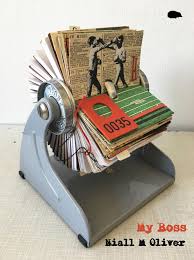


 Damien B. Donnelly